How to Choose a Dual Exhaust System?
Choosing a Dual Exhaust System is not just about adding a deeper note or two polished tailpipes. The right setup must suit your engine, vehicle, and daily driving. A system that sounds sharp during a short clip may drone on a long highway trip. That detail matters.
Automotive author and engine builder David Vizard has written extensively about engine performance and airflow. A concise paraphrase of the principle behind that work is: “Match exhaust flow to the engine and its real use.” This is not a verbatim quotation. It is a useful reminder that bigger pipes do not automatically mean better results. Engine size, existing modifications, pipe diameter, and muffler design all affect how a system performs. So does fitment. Check the vehicle’s year, model, engine, and clearance before comparing products.
This guide explains the main dual-exhaust layouts, materials, sound characteristics, and fitment details to consider. It also covers the trade-offs between a balanced, quiet setup and a louder, more noticeable one. A stainless-steel system may resist corrosion well, but its price can be higher. Sound demonstrations help, though recordings rarely reproduce cabin drone accurately. Be cautious there. The best choice is the one that fits your vehicle and routine—not simply the one with the biggest tips. It is easy to overlook small details, and some choices may need reconsideration after real-world driving.
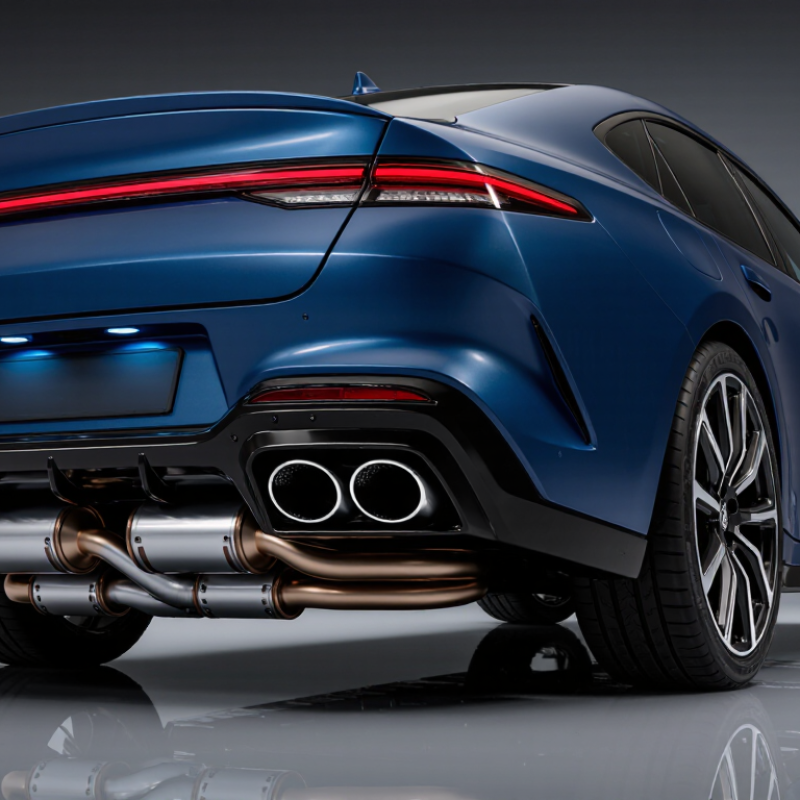
Identify True-Dual and Y-Pipe Layouts by Tracing Their Exhaust Flow Paths
How to Choose a Dual Exhaust System?
Identify True-Dual and Y-Pipe Layouts by Tracing Their Exhaust Flow Paths
Start at the exhaust manifolds and follow each pipe toward the rear. In a true-dual layout, two exhaust paths remain separate to their outlets, though a crossover may connect them. In a Y-pipe layout, two branches meet at a junction and continue through one shared pipe. Follow the metal, not the number of tailpipes: a single outlet can hide a split upstream, and two visible tips do not prove two independent paths. Look beneath the vehicle for the Y-shaped merge.
The U.S. Environmental Protection Agency’s 2024 Automotive Trends Report puts model-year 2023 new-vehicle real-world fuel economy at 27.1 mpg, a record for its dataset. That fleet-wide figure does not compare exhaust layouts or predict a specific vehicle’s gains. Engine design, pipe diameter, mufflers, and calibration all affect results. A louder note is not proof of better flow. I’d inspect the routing before trusting a catalog label.
Tips: Use a flashlight and trace both pipes from front to rear. Find the merge point, if present. Check for crushes, leaks, and clearance near the axle. Photograph the route. It is easy to misread a crossover as a Y-pipe at a quick glance.
Compare Common 2.25-, 2.5-, and 3-Inch Pipe Diameters Against Engine Needs
Choosing a dual exhaust diameter is a balance between flow capacity and gas velocity. Assuming the listed sizes are internal diameters, circular-area calculations give about 3.98 square inches for 2.25-inch pipe, 4.91 for 2.5-inch, and 7.07 for 3-inch. That means 2.5-inch pipe offers roughly 23% more area than 2.25-inch pipe; 3-inch adds about 44% over 2.5-inch. These are geometric calculations, not horsepower guarantees. SAE technical literature on engine gas exchange also treats flow as a system issue, shaped by pressure waves and engine speed.
For a near-stock, smaller-displacement engine, 2.25-inch tubing may suit modest output and restrained noise. A stronger street engine often benefits from 2.5-inch tubing, especially with increased displacement or higher-rpm use. Three-inch pipe is more appropriate when airflow demand is genuinely high, such as with substantial power upgrades. Too large can reduce gas velocity at lower engine speeds, though the full system design matters. I would not choose diameter from engine size alone; cam timing, collectors, bends, and mufflers change the result.
Tips: Measure actual inside diameter, not just the advertised size. Compare with a reputable engine-builder flow chart, then verify against dyno data for a similar setup. Small detail, big difference. If measurements or results conflict, pause and reassess—the neatest rule of thumb may not fit your build.
Check Catalysts, Oxygen Sensors, and OBD-II Readiness Under Local Emissions Rules
How to Choose a Dual Exhaust System?
Before comparing pipe diameter or sound, check how a dual exhaust layout affects emissions equipment. Catalytic converters need to remain compatible with the vehicle and its required configuration. Oxygen sensors also need correct placement and reliable wiring. A sensor moved too far from its intended position may report readings that the engine computer cannot interpret properly. Small details matter.
Ask a qualified exhaust technician to confirm the proposed system works with your vehicle’s existing catalysts and sensors. Do not assume that two tailpipes require two of every emissions component. The correct arrangement depends on the engine and original exhaust design. Local inspection rules vary, so check the requirements where the vehicle is registered. A clean-looking installation is not proof of compliance.
After installation, use a suitable scan tool to check for diagnostic trouble codes and OBD-II readiness. Some monitors may show “not ready” until the vehicle completes specific driving conditions, such as a cold start or steady-speed trip. Inspection too soon can cause an avoidable problem. Keep the paperwork and ask what testing was performed. I would not rely on a dashboard warning light alone; it can be off while a monitor remains incomplete. That distinction is easy to miss.
Choose Mufflers and Verify Stationary Noise Using SAE J1169 Test Procedures
How to Choose a Dual Exhaust System?
Choose Mufflers and Verify Stationary Noise Using SAE J1169 Test Procedures
Choose mufflers by comparing their internal design, outlet size, and published sound measurements—not appearance alone. For a dual exhaust, matched mufflers can help keep tone and flow balanced across both outlets. Check whether test results identify the vehicle, engine speed, microphone position, and test method. Without those details, two decibel figures may not be meaningfully comparable. A deep tone can sound restrained at idle, then become harsh under load. Small differences matter.
Use the current SAE J1169 procedure to assess stationary exhaust sound. Follow its specified microphone placement, engine speed, and operating sequence; keep the surface, vehicle condition, and surroundings consistent. A phone app is useful for rough comparisons, but it is not a substitute for calibrated test equipment. NIOSH’s 1998 Criteria for a Recommended Standard: Occupational Noise Exposure explains that a 3 dB increase represents about twice the acoustic energy, though listeners do not perceive it as twice as loud. That is a useful scale check. It is easy to chase a richer note and overlook a modest measured increase. Record each configuration, repeat the test, and investigate unexpected variation before choosing.
Compare 409 Stainless Steel (≥10.5% Chromium) with 304 (18–20% Chromium)
A dual exhaust system faces heat, condensation, road salt, and repeated cool-downs. Material choice affects how its pipes age. ASTM A240/A240M specifies 409 stainless steel with at least 10.5% chromium, while 304 contains 18–20%. These figures describe alloy composition, not a guaranteed service life. Nickel Institute technical guidance explains that chromium helps stainless steel form a protective oxide film. More chromium generally improves corrosion resistance, but exhaust conditions still matter.
Type 409 is a ferritic stainless steel commonly selected for exhaust components because it handles heat cycling and can cost less than 304. Its surface may develop brown discoloration or light rust, especially where salt and moisture collect near welds. That can look worse than it is. Type 304’s higher chromium, plus its nickel content, typically offers stronger resistance to atmospheric and chloride corrosion. However, it is not immune to pitting in salty environments. ASTM composition limits help compare the grades, but they cannot predict the life of a specific system. Check the vehicle’s climate, winter road treatment, and expected ownership period; a dry garage and coastal parking are very different tests. I would not treat the more expensive alloy as automatically necessary. Conversely, visible rust on 409 deserves inspection, not an instant verdict.
How to Choose a Dual Exhaust System?
Compare chromium content in 409 and 304 stainless steel
Common specified chromium ranges are 10.5–11.75 wt.% for Type 409 and 18–20 wt.% for Type 304. Type 304’s higher chromium content generally supports better corrosion resistance, while Type 409 is commonly used for exhaust applications and is often a more economical option. Actual durability depends on the full alloy composition, fabrication, and service environment.
